
Sanctions in a Snap: Developments in Sanctions January 2026
A summary of recent developments from OFAC.
Hughes Hubbard’s “Sanctions in a Snap” is intended to provide a clear and concise summary of recent developments from the Office of Foreign Assets Control (OFAC). We hope you find it helpful in assessing U.S. economic sanctions compliance risk against current U.S. government designation and enforcement priorities.
Highlights from January 2026 include OFAC authorizations for certain downstream activities involving Venezuelan oil and negotiations for the eventual acquisition of Lukoil’s international assets and a counternarcotics designation announcement that should inform compliance controls for transactions with Costa Rica’s Puerto Moin.
ln total, OFAC added 84 individuals and entities toits Specially Designated Nationals and Blocked Persans List (SDN List) and identified 10 vessels as blocked property.
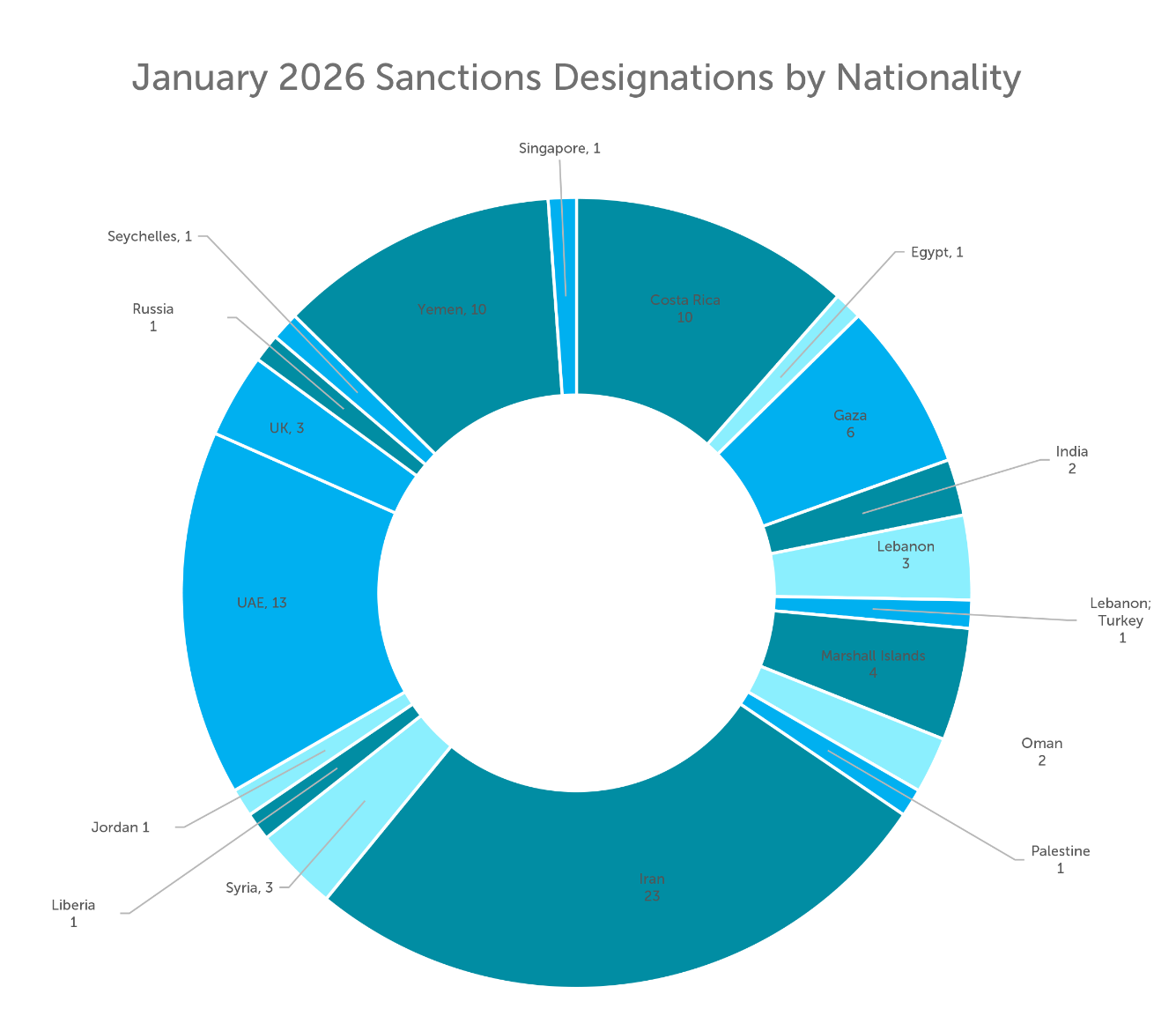
The January sanctions designations focus on lranian oil and petrochemicals - almost half of the actions target those sectors of the lranian economy. OFAC concentrated its lranian oil/petrochemical actions against alleged United Arab Emirates-based facilitators rather than the lndian or Chinese purchasers of those products.
lranian nationals purportedly responsible for the crackdown on demonstrators constitute a significant portion of the remaining designations. While those listings likely do not directly affect the sanctions risk exposure for any particular company or bank, the totality of the U.S. pressure on Iran across all sanctions programs portends increasingly aggressive targeting of lran’s business and trading partners.
The graph at the end of this update provides a visual representation of the current targeting priorities reflected in the January designations.
Downstream Activities Involving Venezuelan Oil
On Jan. 29, OFAC issued Venezuela-related General License 46, “Authorizing Certain Activities lnvolving Venezuelan-Origin Oil.”
The license is uniquely only available to entities formed under the laws of the United States on or before Jan. 29 engaging in certain transactions involving Venezuelan oil, including storage, transportation, refining and “lifting,” among others. Notably, the license does not authorize transactions conducted by non-U.S. entities, which remain prohibited from using U.S. dollars for their dealings relating to Venezuelan oil.
As of the publication of this monthly summary, OFAC has not provided public guidance or otherwise defined the enumerated categories of authorized transactions. That said, we understand that “lifting” is meant to cover only the so-called downstream activity relating to “the physical loading of oil onto a vessel” and not the upstream use of that term, relating to the production process of bringing oil to the surface.
Please see our comments on the general license published by Reuters and the Financial Times and Energy Intelligence.
Please see our comments published by Global Investigations Review on the potential sanctions and legal risks for U.S. companies looking to enter Venezuela following President Donald Trump’s recent efforts to get U.S. business to return to the country.
Negotiation for Lukoil’s International Assets
On Jan. 14, OFAC issued Russia-related General License 131B, “Authorizing Certain Transactions for the Negotiation of and Entry lnto Contingent Contracts for the Sale of Lukoil International GmbH and Related Maintenance Activities.”
The license authorizes entry into contingent contracts, including agreements in principle and binding memoranda of understanding, relating to the sale, disposition or transfer of Lukoil International GmbH, the Austrian arm of the Russian oil major that owns most of that company’s international assets. Absent further amendments, negotiations must be concluded by Feb. 28.
Please see our comments published by Energy Intelligence on this license, including how nationalization and contractual preemption rights effect the authorization.
Enhanced Costa Rica-Related Risk
Companies trading with or operating in Costa Rica, and the banks involved in those transactions, should consider how an OFAC press release announcing counternarcotics designations may enhance their sanctions risk exposure.
On Jan. 22, OFAC announced the designations of Costa Rican nationals and entities allegedly involved in narcotics trafficking and money laundering. That announcement describes the Moîn seaport as “a key regional transshipment hub for cocaine,” that “[c]riminal groups have continually fought to control [.]” By way of background, that port is a major economic hub operated by the A.P. Moller-Maersk entity APM Terminals.
Please see our recent article “Handling Sanctions Risk Cartel Control Brings to Mexico Port,” which provides risk mitigation considerations relevant to dealings with the Puerto Moin port.
Additional Sanctions Actions in January 2026
Designations (additions to the Specially Designated Nationals and the Consolidated Sanctions Lists)
Jan. 13 – One Lebanese individual and three Muslim Brotherhood entities based in Lebanon, Egypt and Jordan.
Jan. 15 – Eleven lranian individuals and 13 entities based in Iran and the UAE for alleged involvement in serious human rights abuses, acting for or on behalf of the Supreme Leader of Iran or the lranian Revolutionary Guard Corps (IRGC), or for operating in the petroleum or financial sectors of Iran.
Jan. 16 – Twenty-one individuals and entities allegedly linked to the lranian-backed terrorist group Ansarallah, commonly known as the Houthis. The designated individuals are primarily Syrian and Yemeni, though the designations also include a Russian and lndian individual.
Jan. 21 – OFAC announced the designation of one Palestinian individual and six Gaza-based medical organizations, all allegedly tied to the military wing of Hamas. The organizations allegedly provided support to Hamas while purporting to operate independently.
Jan. 23 – Nine entities based in lndia, Liberia, Oman, the Seychelles, the UAE and the Marshall Islands for allegedly operating in the petroleum or petrochemical sectors of Iran. OFAC concurrently identified nine vessels as blocked property of those entities.
Jan. 30 – Seven Iranian individuals, including a dual national of the UAE, and two UK-registered digital asset exchanges. Six of the individuals allegedly engaged in serious human rights abuses by the government of Iran. The remaining individual and two entities allegedly operate in the financial services sector of Iran and provide financial services to the IRGC.
Sanctions List Removals
Jan. 8 – OFAC removed sanctions imposed against a Cypriot individual, who was previously sanctioned under the Russia-related program.
Jan. 21 – OFAC removed sanctions imposed against a Greek entity and its Panamanian-flagged vessel. The entity was sanctioned pursuant to the counterterrorism authority.
Jan. 30 – OFAC removed sanctions imposed against a Bruneian entity, previously sanctioned under the weapons proliferation authority.
General Licenses
Russia-related General License 13P (Jan. 6), "Authorizing Certain Administrative Transactions Prohibited by Directive 4 under Executive Order 14024."
Regulations and Guidance
FAQ
Miscellaneous
Quarterly Report of Licensing Activities
On Jan. 21, OFAC released its Trade Sanctions Reform and Export Enhancement Act of 2000 fourth-quarter report for fiscal year 2025. The report covers OFAC's licensing determinations for applications seeking authorization to export food, medicine or medical devices to Iran.
U.S. Targeting Priorities
Featured Lawyers

Sanctions in a Snap: Developments in Sanctions
Hughes Hubbard’s “Sanctions in a Snap” provides a clear and concise summary of recent developments from the United States' Office of Foreign Assets Control (OFAC) and the European Union and its Member States.

Stay Up to Date
Sign up to receive practical updates, fresh perspectives and helpful guidance delivered straight to your inbox.
Stay connected for our latest news and insights.