
Sanctions in a Snap: Developments in Sanctions April 2026
A summary of recent developments from OFAC.
Hughes Hubbard’s “Sanctions in a Snap” is intended to provide a clear and concise summary of recent developments from the Office of Foreign Assets Control (OFAC). We hope you find it helpful in assessing U.S. economic sanctions compliance risk against current U.S. government designation and enforcement priorities.
Highlights from April 2026 include a proposed rule that would require OFAC compliance programs, sanctions actions targeting Nicaraguan gold and an additional apparent finding that a Foreign Terrorist Organization (FTO) controls a geographic area in Mexico.
In total, OFAC added 172 individuals and entities to its Specially Designated Nationals and Blocked Persons List (SDN List) and identified 30 vessels as blocked property. OFAC also removed three individuals from the SDN List in April, including the current acting president and attorney general of Venezuela.
Please see our recent article “How Multinationals Should Approach Recent U.S. Sanctions List Removals” published by the Dow Jones Risk Journal, which provides considerations relevant to the April delistings.
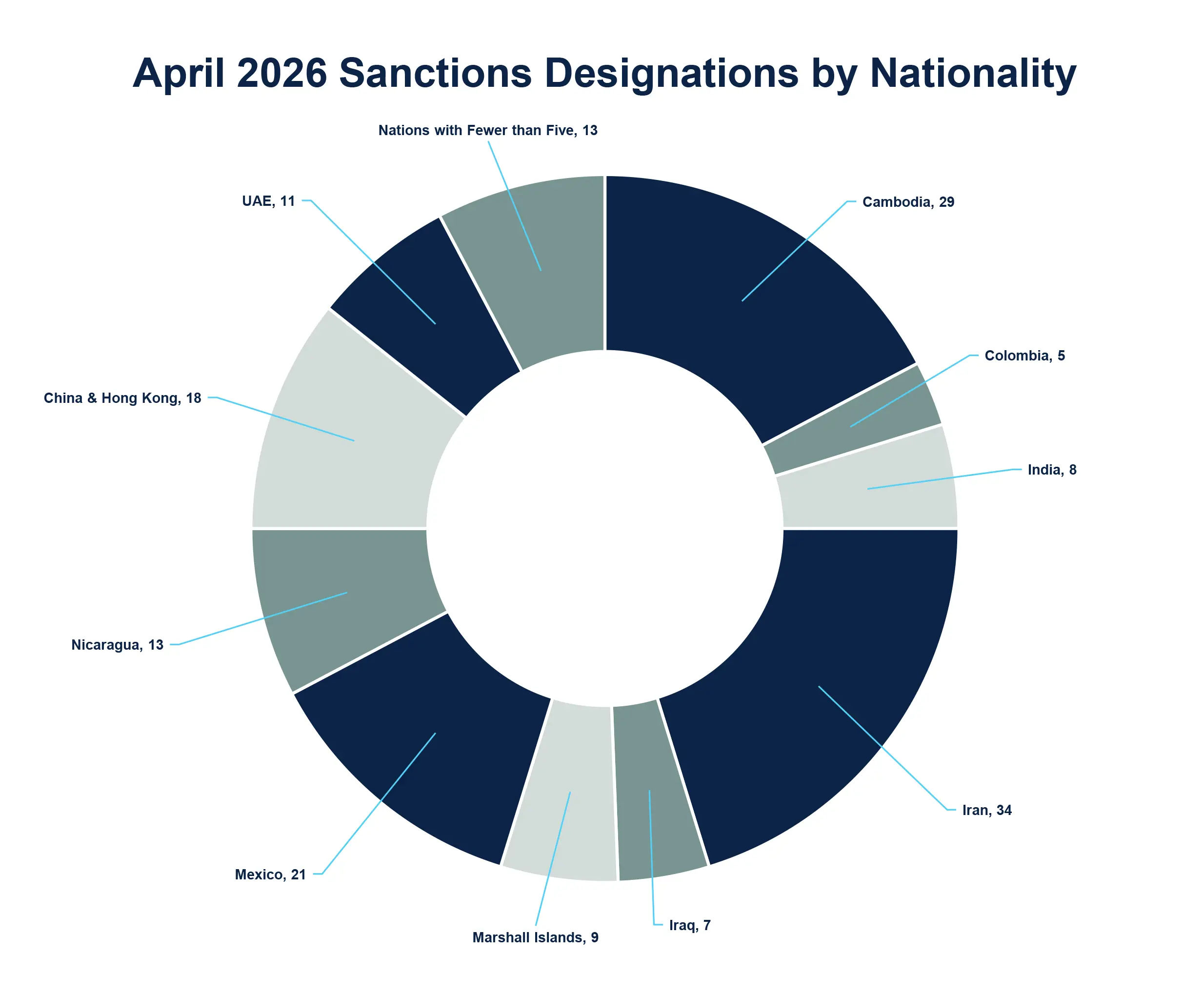
OFAC continued its established trend under the second Trump administration to focus its designations against Mexico and Iran. More than half of the actions target Mexican nationals and companies, or individuals and entities related to their alleged dealings involving Iranian oil/petrochemicals or the Iranian financial services sector.
The graph at the end of this update provides a visual representation of the current targeting priorities reflected in the April designations.
Proposal for First Ever Mandated OFAC Compliance Programs
On April 8, the U.S. Department of the Treasury’s Financial Crimes Enforcement Network (FinCEN) and OFAC issued a joint proposed rule to implement parts of the Guiding and Establishing National Innovation for U.S. Stablecoins Act (GENIUS Act). In relevant part, the proposed rule would require “permitted payment stablecoin issuers” to maintain effective sanctions compliance programs.
All sophisticated international companies should have robust sanctions compliance programs commensurate with their risk profile. Those companies do not, however, have a legal obligation to maintain sanctions compliance programs. In fact, OFAC will only assess the adequacy of a compliance program when considering its enforcement response to apparent violations.
A sanctions compliance program mandate represents a sea change that could be applied to additional high-risk companies.
Sanctions Targeting the Nicaraguan Gold Sector
We predicted that OFAC would likely soon impose sanctions against the Nicaraguan gold sector in our February edition of “Sanctions in a Snap” (“Probable Upcoming Sanctions Targeting the Nicaraguan Gold Sector”). In April, OFAC targeted the Nicaraguan gold sector by designating 12 Nicaraguan individuals and entities and one Chinese national for allegedly operating in that economic sector.
OFAC will likely continue to sanction individuals and entities connected to the Nicaraguan gold trade. Companies with touchpoints to that sector should consider how OFAC’s targeting priority affects their sanctions risk exposure.
Expansion of Mexican Cartel FTO Control Findings
On April 14, OFAC announced the designations of six Mexican individuals and entities, including two casinos, connected to the FTO-designated Cartel del Noreste (CDN). In its press release, OFAC states that CDN exerts “criminal dominance over the Nuevo Laredo plaza in Tamaulipas, Mexico.”
OFAC’s finding that the plaza is controlled by CDN means that, as a matter of law, certain entities associated with that area qualify as agents of the cartel, pursuant to OFAC regulations. Companies and financial institutions should therefore carefully consider how to mitigate the risk arising from their dealings involving the plaza.
Prior similar statements from OFAC connect the following Mexican geographic locations to purported control by cartel FTOs:
Puerto Vallarta (Jalisco New Generation Cartel)
Rosarito (Sinaloa Cartel)
Port of Manzanillo (Jalisco New Generation Cartel)
Additional Sanctions Actions in April
In addition to the OFAC actions summarized above, the U.S. government announced the following in April:
Designations (additions to the Specially Designated Nationals and Consolidated Sanctions lists)
April 15 – Two Indian individuals and one Iranian individual, as well as 17 entities based in the Netherlands, the United Arab Emirates, the Marshall Islands and India. The individuals and entities are allegedly part of the illicit Iranian oil trade and connected to the Shamkhani network. OFAC also identified nine vessels as blocked property, alleging that the vessels are the property of designated individuals.
April 17 – Three Colombian individuals and two Colombian entities allegedly involved with the recruitment and deployment of former Colombian military personnel on behalf of the Sudanese paramilitary group the Rapid Support Forces.
April 17 – OFAC sanctioned seven Iranian individuals, all alleged to be leaders of sanctioned Iraqi militia organizations aligned with Iran.
April 21 – Fourteen individuals, entities and aircraft based in Iran, Türkiye and the United Arab Emirates for their alleged involvement in the procurement and transportation of weapons on behalf of the Iranian regime.
April 23 – Twenty-three Mexican, Guatemalan and Indian individuals and entities allegedly connected to a synthetic opioid procurement network with ties to the Sinaloa Cartel.
April 23 – Twenty-nine Cambodian individuals and entities, including Cambodian Senator Kok An. The sanctioned individuals and entities are allegedly connected to a network of scam centers that have targeted Americans.
April 24 – Thirty-nine entities and shipping vessels, all allegedly connected with the Iranian shadow fleet and illicit oil trade. The entities and shipping vessels are primarily based in Panama and Hong Kong.
April 28 – Thirty-five individuals and entities, primarily of Iranian origin and all allegedly connected to Iran’s shadow banking sector.
April 30 – OFAC sanctioned Joseph Kabange Kabila, the former president of the Democratic Republic of the Congo (DRC), for his alleged support of armed groups that are allegedly responsible for violent conflicts and political instability in the DRC.
General Licenses
Russia-Related General License 13Q (April 8), “Authorizing Certain Administrative Transactions Prohibited by Directive 4 under Executive Order 14024.”
Venezuela General License 56 (April 14), “Authorizing Commercial-Related Negotiations of Contingent Contracts with the Government of Venezuela.”
Venezuela General License 57 (April 14), “Authorizing Financial Services Transactions Involving Certain Venezuelan Banks and Government of Venezuela Individuals.”
Counterterrorism General License 35 (April 14), “Authorizing the Wind Down of Transactions Involving Entities Blocked on April 14, 2026.”
Russia-Related General License 128C (April 14), “Authorizing Transactions Involving Certain Lukoil Entities in Bulgaria.”
Nicaragua-Related General License 5 (April 16), “Authorizing the Wind Down of Transactions Involving Exportadora de Metales Sociedad Anonima.”
Russia-Related General License 134B A (April 17), “Authorizing the Delivery and Sale of Crude Oil and Petroleum Products of Russian Federation Origin Loaded on Vessels as of April 17, 2026.”
Cyber-Related General License 2 (April 23), “Authorizing Certain Transactions Involving Anco Water Supply Co. Ltd. Related to the Treatment and Distribution of Drinking Water.”
Iran-Related General License V (April 24), “Authorizing the Wind Down of Transactions Involving Hengli Petrochemical (Dalian) Refinery Co., Ltd.”
Russia-Related General License 131E (April 29), “Authorizing Certain Transactions for the Negotiation of and Entry Into Contingent Contracts for the Sale of Lukoil International GmbH and Related Maintenance Activities.”
Regulations and Guidance
FAQ
On April 8, OFAC issued amended versions of Russia-related FAQ 999 and 1118.
On April 14, OFAC issued Venezuela-related FAQ 1248 to provide additional information about Venezuela-related general licenses.
On April 14, OFAC issued an amended version of Russia-related FAQ 1225.
On April 28, OFAC issued one Iran-related FAQ: FAQ 1249.
On April 29, OFAC issued two amended Russia-related FAQ: FAQ 1224 and 1225.
Miscellaneous
On April 14, OFAC released a Quarterly Report of Licensing Activities, covering activities undertaken by OFAC under Section 906(a)(1) of the Trade Sanctions Reform and Export Enhancement Act from October through December 2025.
On April 28, OFAC released an Iran-related alert, “Sanctions Risk of Dealing with Teapot Oil Refineries.” The alert is intended to provide insight for financial institutions about the sanctions risks associated with independent “teapot” oil refineries in China, primarily in Shandong Province, given their alleged role in the illicit Iranian crude oil trade.
United States Targeting Priorities
Featured Lawyers

Sanctions in a Snap: Developments in Sanctions
Hughes Hubbard’s “Sanctions in a Snap” provides a clear and concise summary of recent developments from the United States' Office of Foreign Assets Control (OFAC) and the European Union and its Member States.

Stay Up to Date
Sign up to receive practical updates, fresh perspectives and helpful guidance delivered straight to your inbox.
Stay connected for our latest news and insights.