
Sanctions in a Snap: Developments in Sanctions October 2026
A summary of recent developments from OFAC.
Hughes Hubbard’s “Sanctions in a Snap” is intended to provide a clear and concise summary of recent developments from the Office of Foreign Assets Control (OFAC). We hope you find it helpful in assessing U.S. economic sanctions compliance risk against current U.S. government designation and enforcement priorities.
Highlights from October 2026 include OFAC’s temporary Russian diesel authorization, further economic isolation of Iran through Operation Economic Outcast, and three enforcement actions that clearly demonstrate OFAC’s enforcement priorities.
In total, OFAC added 134 individuals and entities and 33 vessels to its List of Specially Designated Nationals and Blocked Persons (SDN List) and added five entities to the Non-SDN Menu-Based Sanctions List.
OFAC also removed 131 individuals and entities and two vessels from the SDN List.
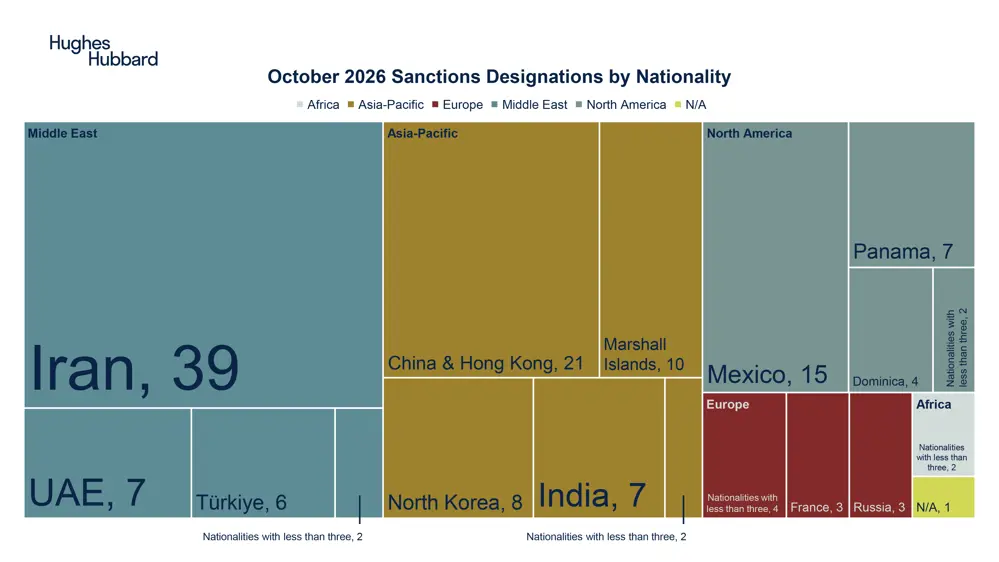
The October designations reflect OFAC’s prioritization of Iran, China and Mexico as primary threats to the national security and foreign policy interests of the United States. Notably, China resumed that status following a significant drop-off in designations leading up to the late September Trump-Xi summit.
The graph at the end of this update provides a visual representation of the current targeting priorities reflected in the September designations.
Russian Diesel General License
On Oct. 9, OFAC issued Russia-related General License 135 at the direction of the White House.
This extraordinary general license broadly authorizes transactions involving Russian diesel fuel otherwise prohibited by Russia-related sanctions, including its importation into the United States, until April 7, 2027.
Please see our comments published by Reuters, Financial Times and Fox News, and interview with BBC discussing this general license.
Operation Economic Outcast
OFAC continued to implement Operation Economic Outcast, a sanctions campaign aimed at economically isolating Iran. In addition to targeting the now directly sanctionable automotive and rail sectors, OFAC focused on Iran’s access to the international financial system and its oil and petrochemical sectors.
Additional Targeted Sectors
On Oct. 1, OFAC issued a determination that further expands the scope of sanctionable sectors of the Iranian economy to include the automotive and rail sectors. OFAC concurrently designated 30 individuals and entities, predominantly based in Iran or China, for allegedly operating in various sectors of the Iranian economy, including those newly sanctionable sectors.
Access to the International Financial System
On Oct. 1, OFAC designated a Russia-based banking network for allegedly facilitating Iranian sanctions evasion.
Notably, among other Iran-related designations announced on Oct. 15, OFAC sanctioned a Chinese entity and a major Iraqi bank for allegedly facilitating Iran’s access to the international financial system.
Oil and Petrochemical Sectors
Irrespective of the ongoing naval blockade of Iran, 30% of the October designations target the Iranian oil or petrochemical sectors. Those designations continue to generally target China, India and Türkiye:
Oct. 8 – Seventeen predominantly Chinese or Marshall Island-based entities, for alleged involvement in transporting Iran-origin petroleum or petrochemical products. OFAC also identified 17 vessels as blocked property.
Oct. 8 – Sixteen predominantly Indian or Turkish individuals and entities, for alleged involvement in trading Iran-origin petrochemicals or servicing Iran’s dark fleet. The State Department also identified five vessels as blocked property.
Oct. 21 – Nine mostly Greek-Panamanian dual nationals and Panamanian entities that allegedly provided legal, operations and shipment, or shipping agency services involving the movement of Iranian oil. OFAC also identified nine vessels as blocked property.
Please see our comments published by Bloomberg discussing the action against the Russia-based alleged Iran sanctions evasion network and the Oct. 21 oil and petrochemical designations and related authorizations.
OFAC Enforcement Priorities
Last month, OFAC announced three civil monetary penalties that provide important lessons for companies with any level of sanctions risk exposure. These settlements highlight OFAC’s current enforcement prioritization: sophisticated companies operating internationally that (1) do not cooperate with an OFAC investigation and (2) fail to act on relevant derogatory information obtained in the ordinary course of business.
On Oct. 9, OFAC announced a $175,015 settlement with Pegasus Worldwide Logistics, a logistics company and freight forwarder. According to OFAC, Pegasus did not screen identifiers of a designated Chinese company following its name change and failed to provide fulsome responses to an OFAC subpoena.
On Oct. 13, OFAC announced an $11,662,930 settlement with Bank of America. OFAC identified 475 apparent violations, the majority of which occurred well after the bank identified but did not resolve the root cause of the apparent violations. OFAC determined that the bank was uncooperative with its investigation by providing incomplete and delayed disclosures.
On Oct. 27, OFAC announced a $1,529,685 settlement with Extreme Networks Inc., an artificial intelligence and cloud networking solutions provider. According to OFAC, Extreme failed to act on purchase orders, correspondence and portal registration responses indicating that the true end user of its products and services was a Russian defense manufacturer subject to sanctions under the 50 Percent Rule.
Additional Sanctions Actions in October
In addition to the OFAC actions summarized above, the U.S. government announced the following in September:
Designations (additions to the Specially Designated Nationals and Consolidated Sanctions Lists and the Non-SDN Menu-Based Sanctions List)
Oct. 2 – Four French individuals and entities and one Palestinian individual for their alleged involvement in a Hamas financing network.
Oct. 9 – The State Department imposed blocking sanctions against the International Criminal Court.
Oct. 13 – Fifteen Mexican individuals and entities involved in quarter horse racing, construction, trucking, or the oil and gas sector and allegedly connected to Cartel del Noreste.
Oct. 15 – A Cuban state-owned bank for operating in the financial services sector of the Cuban economy.
Oct. 19 – Five China-based entities for alleged involvement in the significant theft of trade secrets of United States persons. Notably, the identifiers of these sanctioned entities appear on the Non-SDN Menu-Based Sanctions List, but the entities are blocked under Section 2(b)(1)(A) of the Protecting American Intellectual Property Act.
Oct. 28 – The Rwandan Ministry of Defence and Zigama Credit and Savings Society, a Rwanda-based financial institution, for allegedly providing support for, or goods or services in support of the Rwanda Defence Force (RDF) and the RDF, M23, and the Congo River Alliance, respectively.
Oct. 28 – Two Russian individuals, eight North Korean individuals and one Russia-based entity for alleged involvement in North Korea government-run information technology worker schemes.
Sanctions List Removals
Oct. 5 – 125 individuals and entities of various nationalities previously sanctioned under the Iraq, counterterrorism, Venezuela or Belarus programs.
Oct. 8 – Two Liberia flagged vessels previously identified as blocked property under the Iran-related program.
Oct. 9 – One Burmese individual previously designated under the Burma-related program.
Oct. 14 – The president of the National Assembly of Venezuela, an individual previously designated under the Venezuela-related program.
Oct. 21 – Two Chinese entities, one Chinese individual and one Belarusian individual sanctioned under the North Korea and Belarus programs, respectively.
General Licenses
Iran-related General License EE (Oct. 8), “Authorizing the Wind Down of Transactions Involving Samudra Marine Services Private Limited.”
Russia-related General License 13S (Oct. 8), “Authorizing Certain Administrative Transactions Prohibited by Directive 4 under Executive Order 14024.”
International Criminal Court-related General License 13 (Oct. 9), “Authorizing Certain Transactions Involving the International Criminal Court.”
International Criminal Court-related General License 14 (Oct. 9), “Authorizing Certain Transactions Related to Telecommunications and Enterprise Software Involving the International Criminal Court.”
International Criminal Court-related General License 15 (Oct. 9), “Authorizing Transactions Related to Pension Payments Involving the International Criminal Court.”
International Criminal Court-related General License 16 (Oct. 9), “Authorizing Certain Transactions Related to Certain International Criminal Court Detainees.”
Russia-related General License 128D (Oct. 15), “Authorizing Certain Transactions Involving Lukoil Retail Service Stations Located Outside of Russia.”
Russia-related General License 130B (Oct. 15), “Authorizing Transactions Involving Certain Lukoil Entities in Bulgaria.”
Iran-related General License FF (Oct. 15), “Authorizing the Wind Down of Transactions Involving International Development Bank for Investment and Finance.”
Venezuela-related General License 60A (Oct. 16), “Authorizing Transactions Related to Earthquake Relief Efforts in Venezuela.”
Protecting American Intellectual Property Act of 2022 (PAIPA) General License 1 (Oct. 19), “Transactions Authorized Pursuant to the Cyber-Related Sanctions Regulations.”
Protecting American Intellectual Property Act of 2022 (PAIPA) General License 2 (Oct. 19), “Authorizing the Wind Down of Transactions Involving Certain Entities Blocked on October 19, 2026.”
Iran General License GG (Oct. 21), “Authorizing the Wind Down of Transactions Involving Karnakis and Karnakis.”
Iran General License HH (Oct. 21), “Authorizing Wind Down Activities, Limited Safety and Environmental Transactions, and the Offloading of Cargo Involving Certain Persons or Vessels Blocked on October 21, 2026.”
Russia-related General License 131K (Oct. 21), “Authorizing Certain Transactions for the Negotiation of and Entry Into Contingent Contracts for the Sale of Lukoil International GmbH and Related Maintenance Activities.”
Iran General License FF-1 (Oct. 29), “Authorizing the Wind Down of Transactions Involving International Development Bank for Investment and Finance.”
Regulations and Guidance
Frequently Asked Questions
On Oct. 1, OFAC updated Iran-related FAQ 831 to include language relating to the secondary sanctions risk exposure arising from transactions or dealings with persons sanctioned for operating in certain sectors of the Iranian economy.
On Oct. 5, OFAC updated Iran-related FAQ 156 to reference the Notice to Foreign Financial Institutions Conducting Business with Iran issued that same day.
On Oct. 15, OFAC issued Cuba-related FAQ 1276 to explain the risk exposure to non-U.S. banks that continue to deal with Banco Internacional de Comercio following its designation.
On Oct. 15, OFAC issued technical amendments to Russia-related FAQ 1225 relating to certain authorizations involving Lukoil International GmbH.
On Oct. 16, OFAC issued technical amendments to Venezuela-related FAQ 1263.
On Oct. 21, OFAC issued technical amendments to Russia-related FAQ 1224 relating to the potential sale of Lukoil International GmbH assets.
On Oct. 21, OFAC issued technical amendments to Russia-related FAQ 1225 relating to certain authorizations involving Lukoil International GmbH.
On Oct. 26, OFAC updated FAQs 10, 32, 33, 34, 35, 36, 41, 42, 49, 50 and 53 to provide current guidance on blocking and rejecting transactions and filing reports with OFAC.
Alert
On Oct. 5, OFAC issued a Notice to Foreign Financial Institutions Conducting Business with Iran, warning of the agency’s expanded secondary sanctions authority and recent Treasury actions targeting non-Iranian financial institutions.
United States Targeting Priorities
Featured Lawyers

Stay Up to Date
Sign up to receive practical updates, fresh perspectives and helpful guidance delivered straight to your inbox.
Stay connected for our latest news and insights.