
Sanctions in a Snap: Developments in Sanctions March 2026
A summary of recent developments from OFAC.
Hughes Hubbard’s “Sanctions in a Snap” is intended to provide a clear and concise summary of recent developments from the Office of Foreign Assets Control (OFAC). We hope you find it helpful in assessing U.S. economic sanctions compliance risk against current U.S. government designation and enforcement priorities.
Highlights from March 2026 include:
Unprecedented authorizations involving Russian and Iranian oil
A sanctions advisory providing factors that will lead to aggressive enforcement
A $1.1 million civil monetary penalty demonstrating the importance of the testing and auditing component of sanctions compliance programs
OFAC’s administration of its Specially Designated Nationals and Blocked Persons List (SON List) in March was remarkable. OFAC added 34 individuals and entities to the SON List and removed 33 individuals and entities and four vessels. Monthly net losses to the SON List are highly unusual in the absence of program revocations.
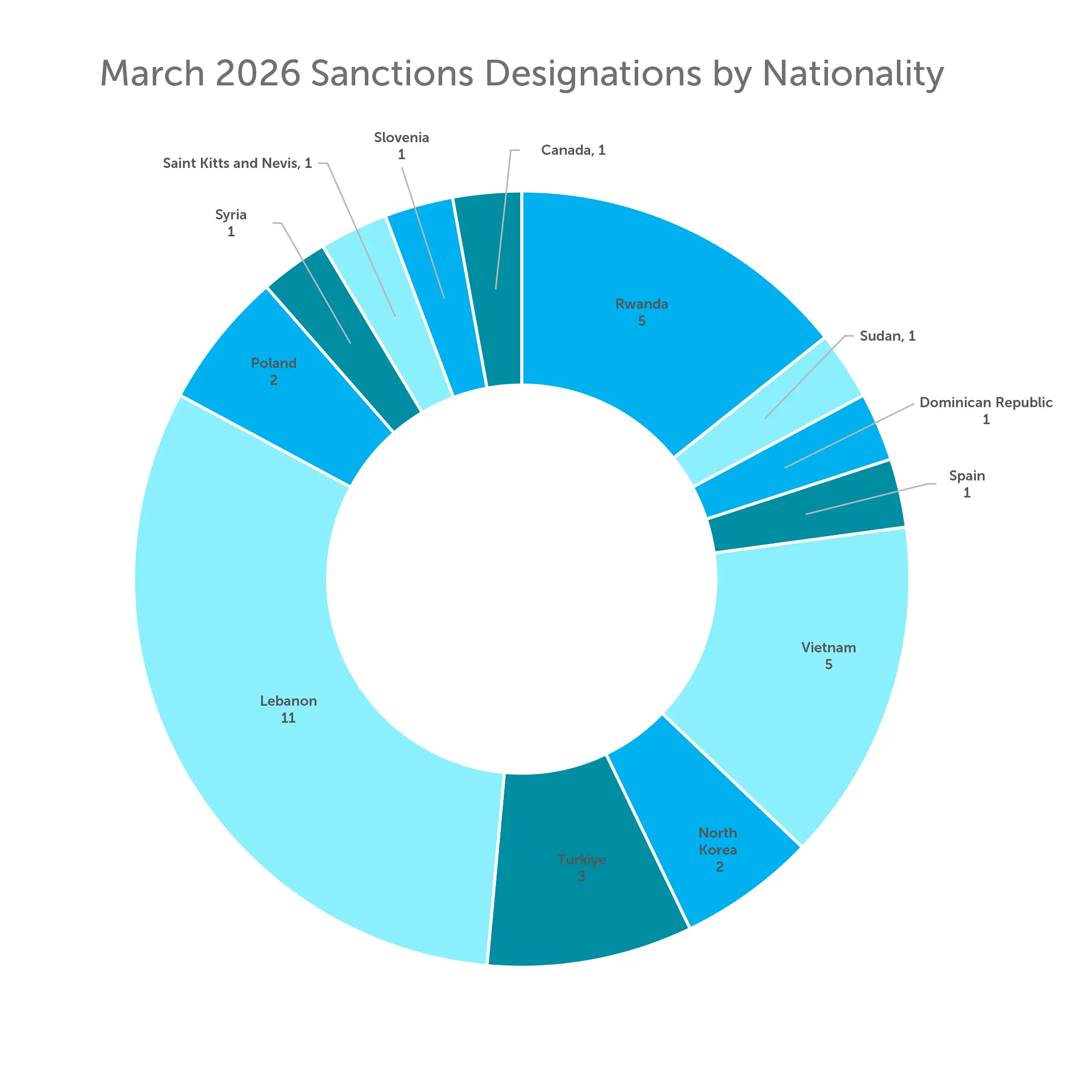
The March sanctions designations primarily focus on counterterrorism actions targeting Lebanon - about 60% of the March designations were based on the counterterrorism authority, with half of those actions against Lebanese nationals or entities.
The graph at the end of this update provides a visual representation of the current targeting priorities reflected in the March designations.
Notably, OFAC did not focus on sanctions targeting but rather general licenses (authorizations of otherwise prohibited transactions) and frequently asked questions (interpretations). Those authorizations and interpretations reflect the Trump administration’s national security and foreign policy prioritization more accurately than the March designations.
In total, OFAC issued 14 separate announcements of new or amended general licenses in the following programs:
Venezuela (6)
Russia (5)
Belarus (1)
Iran (1)
Democratic Republic of the Congo (DRC) (1)
OFAC issued six announcements of new or amended FAQs - five for the Venezuela program and one related to Russia.
Unprecedented Authorizations Involving Iranian and Russian Oil
In March, OFAC issued three general licenses and one amended license authorizing transactions involving Iranian- and Russian-origin oil loaded on vessels on or before the effective date of the respective licenses.
On March 5, OFAC issued Russia-related General License (GL) 133, authorizing transactions related to the purchase and delivery of Iranian oil to India until April 4. OFAC issued Russia-related GL 134 on March 12, expanding on GL 133 by removing the limitation on Indian purchases and deliveries and extending the deadline to April 11. OFAC issued Russia-related GL 134A on March 19 to explicitly remove authorization for transactions involving persons or entities in Iran, North Korea, Cuba or the Crimea region of Ukraine, or entities owned or controlled by or in a joint venture involving those comprehensively sanctioned jurisdictions.
By way of background, prior to March, the United States has prohibited the importation of Iranian oil since 1987 and broadly prohibited any transactions involving Iranian oil since 1995. On March 20, OFAC broke that long-standing policy seeking to limit Iranian oil revenue generation when it issued Iran-related GL U, which authorizes the delivery and sale of Iranian oil loaded onto vessels as of that date until April 19.
Please see our comments on GL 133 published by Compliance Week and our analysis of the delivery of Russian oil to Cuba published by The Washington Post.
Sanctions Advisory: Guidance on Sham Transactions and Sanctions Evasion
On March 31, OFAC issued a sanctions advisory providing certain warning signs that transactions may involve attempts to obscure connections to sanctioned individuals or entities, or blocked property.
Notably, this advisory does not establish new, enhanced compliance expectations. Each sanctions program is unique, but risk-based OFAC compliance has always generally required due diligence sufficient to mitigate risk exposure.
The advisory implies, but does not explicitly state, a long-standing aspect of sanctions compliance emphasized in several recent OFAC enforcement actions: Providing a service, the benefit of which is received by a party subject to U.S. sanctions, is a violation of law. Willfulness and the nexus to the sanctioned individual or entity is relevant when OFAC considers its enforcement response, but sanctions compliance is strict liability. In other words, the individuals or entities between a service provider and a sanctioned party are irrelevant as to whether a violation occurred.
In addition to the implicit reminder of the scope of prohibited services, the advisory provides a clear warning that failure to present defensible data related to the following red-flag indicia of sham transactions and sanctions evasion will result in aggressive OFAC enforcement responses to apparent violations:
Commercially unreasonable transactions
Transfer to family members or close associates
Unclear purpose of transfer
Unduly complex corporate structures involving higher-risk jurisdictions
Continued involvement of a blocked person
Transfer near the time of designation
Evasive responses regarding a blocked person’s involvement
$1.1M Civil Monetary Penalty Against an Online Securities Brokerage Firm
On March 17, OFAC announced a $1,110,661 settlement with TradeStation Securities Inc., a Florida headquartered brokerage firm that operates online securities trading platforms, to resolve potential civil liability arising from apparent violations of the Iran, Syria and Ukraine-Russia sanctions programs. According to OFAC, between 2021 and 2022, TradeStation allegedly engaged in 481 apparent violations of those sanctions programs by processing trades for individuals ordinarily resident in those comprehensively sanctioned jurisdictions.
OFAC found that the apparent violations were voluntarily self-disclosed and non-egregious. Based on those findings, OFAC assessed a base penalty of $2,221,322, equivalent to one-half of the transaction value of each apparent violation.
OFAC reduced the base penalty because the company promptly remediated its compliance program upon discovery of the apparent violations and fully cooperated with OFAC. Further, the apparent violations represent a small percentage of the company’s total transaction volume and TradeStation generated less than $2,000 from the violative transactions.
Root cause of the violations: Failure to detect that multiple geo-blocking controls were disabled or ineffective for almost 12 months. As formally established in A Framework for OFAC Compliance Commitments, OFAC considers testing and auditing a critical component of a sanctions compliance program.
Additional Sanctions Actions in March:
In addition to the OFAC actions summarized above, the U.S. government announced the following in March:
Designations (additions to the Specially Designated Nationals and Consolidated Sanctions lists):
March 2 - OFAC sanctioned the Rwanda Defence Force (RDF) and four Congolese individuals alleged to be senior RDF officials. The RDF is the military force of Rwanda that allegedly supports the U.S.- and U.N.-sanctioned group March 23 Movement, an armed group in the DRC.
March 9 - The U.S. State Department announced the Specially Designated Global Terrorist and Foreign Terrorist Organization designations of the Sudanese Muslim Brotherhood.
March 12 - OFAC sanctioned three entities based in Turkiye and one entity based in Indonesia, alleged to be sham charities affiliated with Hamas.
March 12 - OFAC sanctioned one Spanish individual, four Vietnamese individuals and one North Korean individual, all allegedly affiliated with IT schemes orchestrated by the North Koreans. These schemes allegedly defraud U.S. businesses and help fund the North Korean weapons of mass destruction programs. OFAC also sanctioned one Vietnamese company and one North Korean company for their alleged roles in the scheme.
March 20 - OFAC sanctioned eight Lebanese individuals, one Polish individual and one Syrian individual as well as six entities based in Lebanon, Poland, Slovenia and Canada, allegedly part of a Hezbollah fundraising network.
Sanctions list removals:
March 5 - OFAC removed sanctions imposed against one entity based in the Marshall Islands and one Panamanian-flagged oil tanker, both sanctioned under the Venezuela-related sanctions program.
March 6 - OFAC removed sanctions imposed against an Emirati entity, originally sanctioned under the Russia-related sanctions program.
March 13 - OFAC removed sanctions imposed against one Russian individual, one Finnish individual and four related Finnish entities. The individuals and entities were sanctioned under the cyber-related sanctions program.
March 18 - OFAC removed sanctions imposed against two Turkish individuals, one Russian individual, two Turkish entities and one Emirati entity, previously sanctioned under the Russia-related sanctions program.
March 20 - OFAC removed sanctions imposed against three Mexican individuals, one Hungarian individual, one Uzbek individual, two Russian individuals and an Emirati freight services company. The Mexican individuals were designated as Specially Designated Narcotics Traffickers. The Hungarian, Uzbek and Russian individuals as well as the Emirati company were previously sanctioned under the Russia-related sanctions program.
March 26 - OFAC removed sanctions imposed against two Belarusian entities and one Ukrainian entity, previously sanctioned under the Belarus-related sanctions program.
March 27 - OFAC removed sanctions imposed against one Ukrainian individual and one Ukrainian entity, previously sanctioned under the Global Magnitsky Sanctions program. OFAC also removed sanctions imposed against one Russian individual and one Italian individual, both previously sanctioned under the Russia-related sanctions program.
March 31 - OFAC removed sanctions imposed against two Mexican individuals, one Colombian individual and one Colombian entity, all previously designated as Specially Designated Narcotics Traffickers. OFAC also removed three Russian flagged vessels, originally identified as blocked property under the Russia-related sanctions program.
General Licenses:
DRC-related General License 1 (March 2), “Authorizing the Wind Down of Transactions Involving the Rwanda Defence Force”
Russia-related General License 129A (March 5), “Authorizing Transactions Involving Rosneft Deutschland GmbH and RN Refining & Marketing GmbH”
Venezuela-related General License 51 (March 6), “Authorizing Certain Activities Involving Venezuelan-Origin Gold”
Venezuela-related General License 46B (March 13), “Authorizing Certain Activities Involving Venezuelan-Origin Oil or Petrochemical Products”
Please see our comments on this general license published by Bloomberg.
Venezuela-related General License 48A (March 13), “Authorizing the Supply of Certain Items and Services to Venezuela”
Please see our comments on this general license published by Bloomberg.
Venezuela-related General License 49A (March 13), “Authorizing Negotiations of and Entry Into Contingent Contracts for Certain Investment in Venezuela”
Venezuela-related General License 52 (March 18), “Authorizing Certain Transactions Involving Petr6leos de Venezuela, S.A.”
Venezuela-related General License 5V (March 19), “Authorizing Certain Transactions Related to the Petr6leos de Venezuela, S.A. 2020 8.5 Percent Bond on or After May 5, 2026”
Venezuela-related General License 53 (March 24), “Official Missions of the Government of Venezuela to the United States”
Belarus General License 14 (March 26), “Authorizing Transactions Involving Belarussian Bank of Development and Reconstruction Belinvestbank Joint Stock Company and Certain Additional Entities”
Venezuela-related General License 51A (March 27), “Authorizing Certain Activities Involving Venezuelan-Origin Minerals, Including Gold.”
Venezuela-related General License 54 (March 27), “Authorizing the Supply of Certain Items and Services for Minerals Operations in Venezuela”
Venezuela-related General License 55 (March 27), "Authorizing Negotiations of and Entry Into Contingent Contracts for Certain Investment in Venezuela's Minerals Sector"
Russia-related General License 131D (March 30), "Authorizing Certain Transactions for the Negotiation of and Entry Into Contingent Contracts for the Sale of Lukoil International GmbH and Related Maintenance Activities"
Regulations and guidance:
FAQ
On March 4, OFAC issued six Venezuela-related FAQs, FAQs 1239-1244.
On March 5, OFAC amended Venezuela-related FAQ 1238 to provide additional information about the circumstances in which OFAC would approve the resale of Venezuelan-origin oil for use in Cuba.
On March 13, OFAC amended Venezuela-related FAQs 1226 and 1227, related to General License 46B.
On March 18, OFAC issued Venezuela-related FAQs 1245 and 1246, related to General License 52.
On March 19, OFAC amended Venezuela-related FAQ 595, related to General License 5V.
On March 30, OFAC amended Russia-related FAQs 1224 and 1225, related to General Licenses 128B and 131D.
On March 31, OFAC issued Venezuela-related FAQ 1247, related to General Licenses 46B, 51A, and 52.
Miscellaneous
On March 26, OFAC rescinded Directive 1 under Executive Order 14038, related to prohibited transactions with respect to the Ministry of Finance and Development Bank of the Republic of Belarus. OFAC also archived Belarus-related General License 13.
U.S. Targeting Priorities
Featured Lawyers

Sanctions in a Snap: Developments in Sanctions
Hughes Hubbard’s “Sanctions in a Snap” provides a clear and concise summary of recent developments from the United States' Office of Foreign Assets Control (OFAC) and the European Union and its Member States.

Stay Up to Date
Sign up to receive practical updates, fresh perspectives and helpful guidance delivered straight to your inbox.
Stay connected for our latest news and insights.