
Sanctions in a Snap: Developments in Sanctions May 2026
A summary of recent developments from OFAC.
Hughes Hubbard’s “Sanctions in a Snap” is intended to provide a clear and concise summary of recent developments from the Office of Foreign Assets Control (OFAC). We hope you find it helpful in assessing U.S. economic sanctions compliance risk against current U.S. government designation and enforcement priorities.
Highlights from May 2026 include the transformation of the Cuba embargo into a modern comprehensive sanctions program, terrorism designations against Brazil like those targeting Mexican cartels and a $275 million civil monetary penalty against a prominent India-headquartered multinational.
In total, OFAC added 164 individuals and entities to its Specially Designated Nationals and Blocked Persons List (SDN List) and identified 28 vessels as blocked property. OFAC also removed 62 individuals and entities and 15 vessels from the SDN List in May.
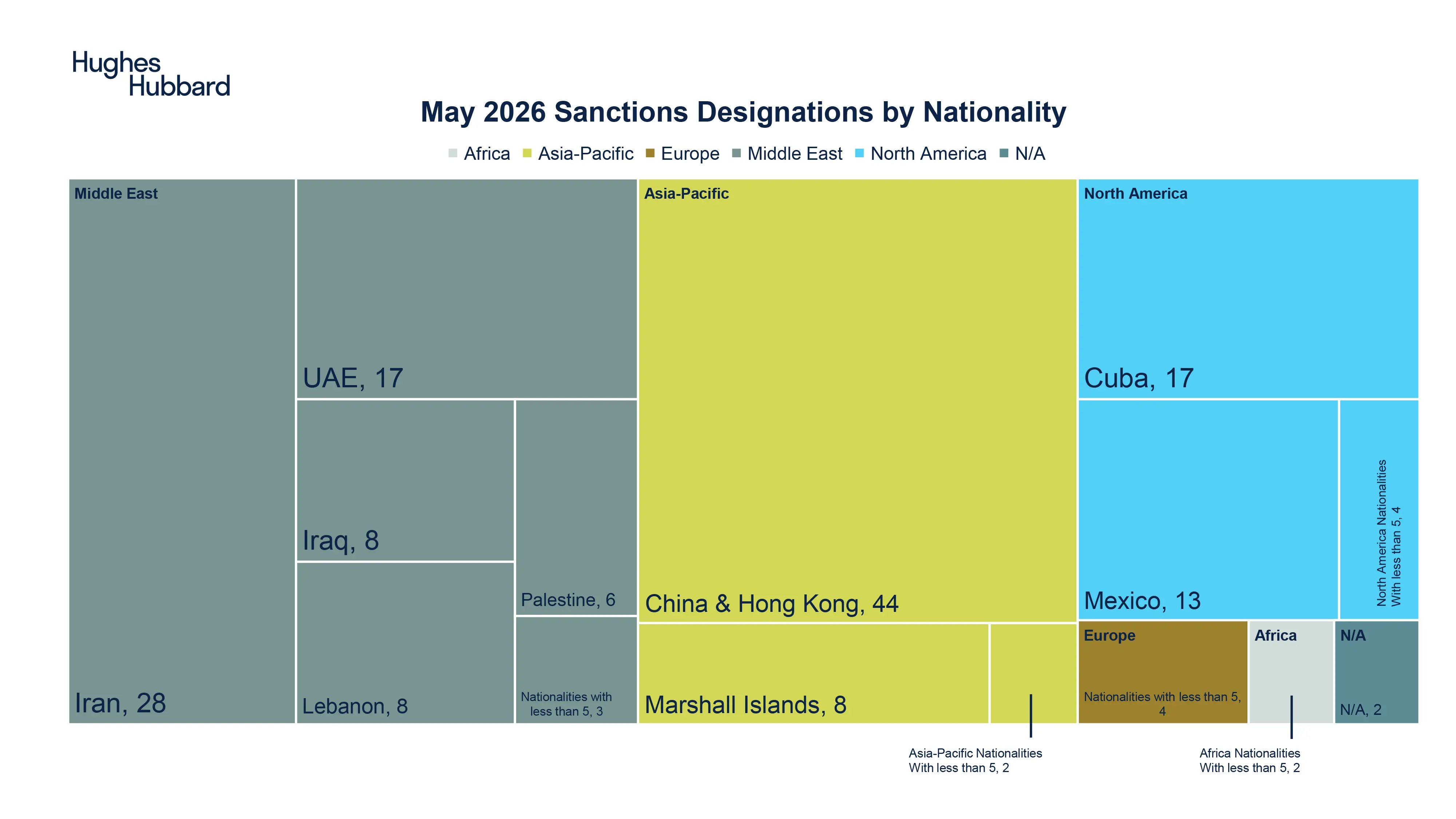
The May designations reflect OFAC’s continued prioritization of Iran generally and in particular that country’s oil and petrochemical sectors. About 40% of the May designations target those Iranian sectors, with Chinese and Emirati companies accounting for half of that subgroup of designations.
Please see our comments on the Trump administration’s “Economic Fury” sanctions campaign against Iran, published by Bloomberg.
The graph at the end of this update provides a visual representation of the current targeting priorities reflected in the May designations.
Enhanced Cuba Sanctions Program
On May 1, President Donald Trump issued Executive Order (EO) 14404, which transforms the 1960s-era Cuba embargo into a modern comprehensive sanctions program akin to Iran. The order exposes non-U.S. individuals, companies and banks to being sanctioned for their dealings with Cuba.
Critically, companies and banks that have separated their Cuba operations from the United States to mitigate their sanctions risk exposure are no longer protected by those ring-fence protocols.
Please see our comments published by Reuters describing this order as the most significant development in the history of the U.S. embargo against Cuba.
Please also see our full analysis of the new Cuba sanctions program, published by Law360.
Terrorism Designations Targeting Brazil
On May 28, Secretary of State Marco Rubio announced the immediate terrorism designations of Primeiro Comando do Capital (PCC) and Comando Vermelho (CV), with separate Foreign Terrorist Organization designations of those groups taking effect on June 5. Notably, a 2021 OFAC press release describes PCC as “the most powerful organized crime group in Brazil and among the most powerful in the world.”
The May 28 terrorism designations significantly enhance the legal risk exposure of every multinational and bank connected to Brazil.
The U.S. may prosecute non-U.S. companies that knowingly provide the groups “material support” (a misnomer as the provision of “any property, tangible or intangible, or service” could support an indictment and prosecution). Further, dealings involving the groups expose their partners to terrorism-related civil seizures and forfeitures, as well as secondary liability claims under the Anti-Terrorism Act.
With respect to the sanctions risk exposure, it is important to consider that FTO sanctions prohibitions are not strictly list-based, and the Specially Designated Global Terrorist designation authorizes OFAC to use a powerful financial intelligence system called the Terrorist Finance Tracking Program.
Please see our comments on the Brazil FTO actions published by the Financial Times.
$275M Civil Monetary Penalty Against Gautam Adani’s Flagship Company
On May 18, OFAC announced a $275 million settlement with Adani Enterprises Limited (AEL), an India-headquartered multinational mining and trading company, to resolve potential civil liability arising from apparent violations of the Iran sanctions program. According to OFAC, from November 2023 to June 2025 AEL allegedly engaged in 32 apparent violations when it caused U.S. financial institutions to facilitate imports of Iranian origin liquefied petroleum gas into India.
OFAC found that the apparent violations were not voluntarily self-disclosed and egregious. Based on those findings, OFAC assessed the base penalty equivalent to the statutory maximum penalty of $384,208,088.
OFAC reduced the base penalty amount based on several mitigating factors, including “prompt disclosure, rapid investigation, and significant cooperation.”
Root cause of the violations: Failure to address several indicators of enhanced risk inherent in the transactions or otherwise readily evident from publicly available information and facts presented in the ordinary course of business.
Please see our comments on this enforcement action published by Global Investigations Review.
Additional Sanctions Actions in May
In addition to the OFAC actions summarized above, the U.S. government announced the following in May:
Designations (additions to the SDN and Consolidated Sanctions lists):
May 1 – Five Iranian individuals and 18 entities based in Iran, China and the UAE, allegedly connected to Iran’s shadow banking sector.
May 1 – One Chinese individual and three entities, allegedly connected to the China-based petroleum terminal operator Qingdao Haiye Oil Terminal Co. Ltd. The State Department also identified a vessel as blocked property. The entities are based in China and the UK, while the vessel is a Panama-flagged oil products tanker.
May 7 – Four entities and four Iraqi individuals, including Iraq’s Deputy Minister of Oil Ali Maarij Al-Bahadly, who allegedly facilitated the diversion of Iraqi oil products to benefit Iran-affiliated oil smugglers and an Iran-backed terrorist militia. The other sanctioned individuals are allegedly affiliated with Iran-backed militias. The sanctioned entities are Iraqi oil companies allegedly affiliated with the designated individuals.
May 7 – The State Department designated one Cuban individual and updated the SDN List entries of two previously designated Cuban entities to reflect their designations pursuant to EO 14404.
May 8 – Belarusian, Iranian and Chinese individuals and nine entities based in China, Belarus and the UAE, allegedly involved in supplying weapons and unmanned aerial vehicle components to Iran.
May 11 – Three Iranian individuals and nine entities based in Oman, Hong Kong and the UAE, allegedly involved in the sale and shipment of Iranian oil to China. The sanctioned individuals are alleged to be senior Islamic Revolutionary Guard Corps (IRGC) officials.
May 18 – Nine Cuban individuals and the Cuban directorate of intelligence, sanctioned pursuant to EO 14404. Additionally, OFAC updated the SDN List entries of two previously designated Cuban individuals, the Cuban ministry of the interior and the Cuban National Revolutionary Police Force to include the EO 14404 program tag.
May 19 – Eight nationals of Palestine, Egypt, Türkiye and Spain, allegedly linked to Hamas and the Muslim Brotherhood, pursuant to the counterterrorism authority.
May 19 – OFAC designated three Iranian individuals, one Turkish individual and 29 entities and identified 19 vessels as blocked property pursuant to EO 13902 for allegedly operating in the petroleum, petrochemical or financial sector of Iran. The sanctioned entities are primarily based in China, the Marshall Islands and Panama, though the designations also included entities based in the UK, the UAE, Liberia, Saint Kitts and Nevis, and the British Virgin Islands.
May 20 – Eleven Mexican individuals and two Mexican entities, allegedly involved in fentanyl trafficking and money laundering activities connected to the Sinaloa cartel.
May 21 – Eight Lebanese individuals and one Iranian individual allegedly connected to Hizballah.
May 27 – OFAC redesignated an Italian national under the International Criminal Court (ICC)-related sanctions program.
May 27 – OFAC designated the Persian Gulf Strait Authority, an Iranian maritime transit agency founded in May 2026, for its alleged link to the IRGC.
May 28 – OFAC and the State Department announced designations of one Indian individual and 16 entities and identified eight vessels as blocked property, all allegedly linked to Iranian oil sales. The designated entities are primarily based in China, the UAE and the Marshall Islands.
May 29 – Eight individuals and four entities that allegedly comprise an Iran-based procurement network that allegedly impersonated and defrauded U.S. companies to procure restricted goods for Iran’s Ministry of Defense and Armed Forces Logistics and other sanctioned Iranian entities. The restricted goods include network security and encryption software and hardware, stolen from American small businesses. The designated individuals are all Iranian, while the entities are based in the UAE and Iran.
Sanctions List Removals:
General Licenses:
Iran-Related General License W (May 1), “Authorizing the Wind Down of Transactions Involving Certain Persons Blocked on May 1, 2026.”
Venezuela General License 5W (May 4), “Authorizing Certain Transactions Related to the Petróleos de Venezuela, S.A. 2020 8.5 Percent Bond on or After June 19, 2026.”
Venezuela General License 58 (May 5), “Authorizing Certain Services to the Government of Venezuela in Connection with Potential Debt Restructuring.”
Cuba General License 1 (May 7), “Transactions Authorized Pursuant to the Cuban Assets Control Regulations.”
Russia-Related General License 134C (May 18), “Authorizing the Delivery and Sale of Crude Oil and Petroleum Products of Russian Federation Origin Loaded on Vessels as of April 17, 2026.”
Russia-Related General License 131F (May 28), “Authorizing Certain Transactions for the Negotiation of and Entry Into Contingent Contracts for the Sale of Lukoil International GmbH and Related Maintenance Activities.”
Regulations and Guidance:
Frequently Asked Questions:
On May 1, OFAC issued Iran-related FAQ 1250 relating to Iranian digital asset exchanges.
On May 4, OFAC issued technical amendments to Venezuela-related FAQ 595.
On May 7, OFAC issued Cuba-related FAQs 1251-1256 relating to the sanctions risk exposure arising from EO 14404.
On May 28, OFAC issued technical amendments to Russia-related FAQ 1224 and FAQ 1225.
On May 29, OFAC issued an amended Iran-related FAQ 1249, which unequivocally states that payment to the so-called Persian Gulf Strait Authority for passage through the Strait of Hormuz is both prohibited and sanctionable.
Guidance:
On May 15, OFAC issued a notice with additional information about the ICC-Related Sanctions Program. The notice included information about general licenses and the legal framework for ICC-related sanctions along with additional guidance, but it was withdrawn following the redesignation of Francesca Paola Albanese on May 27.
Miscellaneous:
On May 1, OFAC published an Iran-Related Alert, “Sanctions Risks of Iranian Demands for Strait of Hormuz Passage,” addressing sanctions risks arising from Iran’s demands for passage fees through the Strait of Hormuz.
U.S. Targeting Priorities
Featured Lawyers

Sanctions in a Snap: Developments in Sanctions
Hughes Hubbard’s “Sanctions in a Snap” provides a clear and concise summary of recent developments from the United States' Office of Foreign Assets Control (OFAC) and the European Union and its Member States.

Stay Up to Date
Sign up to receive practical updates, fresh perspectives and helpful guidance delivered straight to your inbox.
Stay connected for our latest news and insights.