
Sanctions in a Snap: Developments in Sanctions July 2026
A summary of recent developments from OFAC.
Highlights
Hughes Hubbard’s “Sanctions in a Snap” is intended to provide a clear and concise summary of recent developments from the Office of Foreign Assets Control. We hope you find it helpful in assessing U.S. economic sanctions compliance risk against current U.S. government designation and enforcement priorities.
Highlights from July 2026 include actions further increasing the risk exposure arising from Brazil, Ecuador and Mexico.
In total, OFAC added 178 individuals and entities to its Specially Designated Nationals and Blocked Persons List (SDN List) and identified 28 vessels as blocked property.
OFAC also removed 133 individuals and entities from the SDN List this month, including 48 Hong Kong-related designees. Notably, 39 of those delistings were transferred to the Non-SDN Menu-Based Sanctions List with a continuation of blocking and secondary-sanctions risk. This means there is minimal legal effect for most of the July Hong Kong-related SDN delistings.
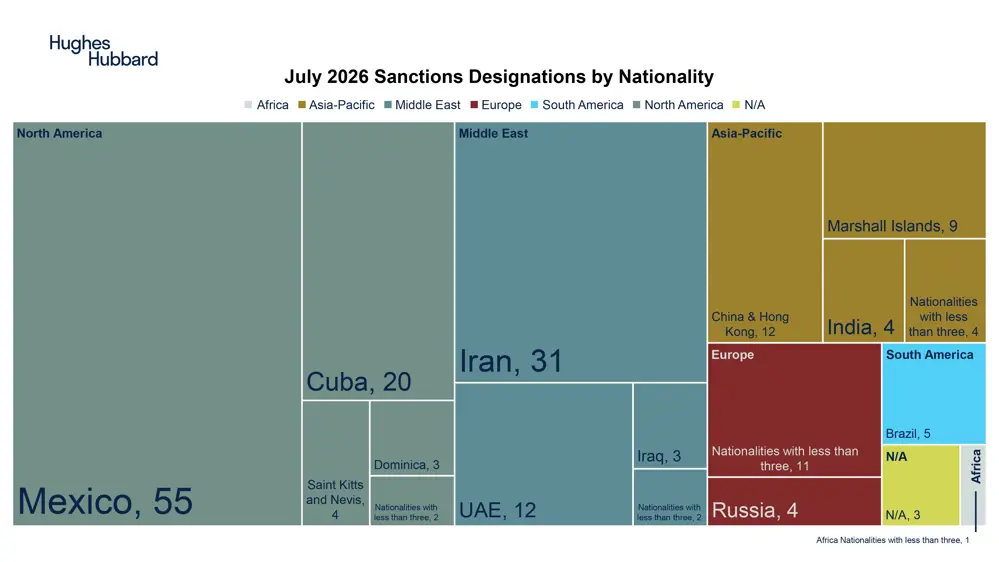
The July actions reflect OFAC’s continued prioritization of Mexico, Iran and Cuba as primary threats to the national security and foreign policy interests of the United States. The graph at the end of this update provides a visual representation of the current targeting priorities reflected in the July designations.
Brazil
On July 1, OFAC announced the first derivative Primeiro Comando da Capital designations since that Brazilian group’s Foreign Terrorist Organization (FTO) listing in June of this year.
Those actions underscore the increasing risk exposure arising from dealings involving Brazil. It is important to note, however, that FTO sanctions are not strictly list-based.
For example, U.S. financial institutions must block “any funds in which [a] foreign terrorist organization or its agent has an interest.” The applicable OFAC regulations define “agent” to include an individual or entity (1) owned by an FTO; (2) controlled by an FTO; or (3) acting or purporting to act directly or indirectly on behalf of an FTO.
OFAC generally makes determinations of “control” and “acting for or on behalf of,” which are reflected in its derivative designation actions. However, U.S. financial institutions are responsible for making these determinations when deciding whether to block the funds in which a potential FTO agent may hold an interest.
Ecuador
On July 1, the State Department announced the Specially Designated Global Terrorist (SDGT) and FTO designations of Chone Killers, an Ecuadorian gang.
Notably, Ecuador is now second only to Mexico as the most targeted country under the FTO authority. Companies and banks connected to Ecuador should consider that targeting prioritization relative to the size of the Ecuadorian economy.
Mexico
On July 15, the State Department announced the SDGT and FTO designations of the Juárez Cartel and Los Viagras, two Mexico-based groups. With those actions, eight of the 18 total LATAM FTOs are based in Mexico.
On July 23, OFAC announced the largest-ever action targeting Cartel de Jalisco Nueva Generacion (CJNG). OFAC designated Mexican companies operating in a variety of industries, including construction, agriculture, logistics, private security, as well as oil and gas for their alleged connections to CJNG.
The continued focus on Mexico will inevitably lead to the imposition of significant monetary penalties in line with OFAC’s long-held principle of “better compliance through enforcement.”
Additional Sanctions Actions in July
In addition to the OFAC actions summarized above, the U.S. government announced the following in July
Designations (additions to the Specially Designated Nationals and Consolidated Sanctions lists)
July 10 – OFAC announced sanctions targeting a network led by Iranian individual Ali Ansari, an alleged financier for Iran’s Supreme Leader. Ansari allegedly manages shadow exchange houses that move funds outside the formal financial system on behalf of sanctioned Iranian banks. The designees include eight Iranian individuals, three entities based in Iran, one entity based in the UAE, one entity based in Saint Kitts and Nevis, and one entity based in Hong Kong.
July 13 – One Ukrainian individual, one Belarusian individual and one Ukrainian entity allegedly responsible for ransomware attacks against United States citizens. The sanctioned entity allegedly sold its services to ransomware groups.
July 13 – OFAC sanctioned 10 Cuban entities allegedly connected to the Cuban regime. The sanctioned entities include state-owned energy companies, a state-owned business group, the Ministry of Tourism of Cuba, paramilitary groups and alleged surveillance organizations.
July 14 –Ten individuals, 24 entities and 20 vessels were sanctioned as part of OFAC’s ongoing efforts to disrupt the illicit shipping network of Mohammad Hossein Shamkhani. The sanctioned individuals, entities and vessels are allegedly part of Shamkhani’s sanctions evasion network, which includes Iranian oil exports, containerized shipping companies and commodities trading. The sanctioned individuals are Iranian, Indian, Italian, Danish, Emirati and British. The sanctioned entities are primarily based in the UAE, the Marshall Islands and Iran. The sanctioned vessels are primarily Iran- and Panama-flagged.
July 15 – Two Russian individuals, one Italian individual and one Iranian individual as well as three related entities. The sanctioned individuals and entities have allegedly participated in weapons procurement efforts on behalf of the Islamic Revolutionary Guard Corps (IRGC). The entities are based in Russia, Iran and Nigeria.
July 23 – OFAC designated four individuals and three entities allegedly affiliated with the Egyptian Muslim Brotherhood. OFAC alleges that the sanctioned individuals and entities provided material support to Hamas.
July 23 – Nine entities and two individuals allegedly connected to the Cuban government’s exploitation of medical workers and evasion of sanctions. The sanctioned entities include companies operating in the Cuban energy sector, the Cuban financial services sector and the container shipping industry. The sanctioned individuals are leaders in the Cuban public health sector.
July 24 – OFAC designated four individuals and nine entities allegedly connected to Iranian financier Babak Zanjani, including businesses and digital-asset platforms alleged to facilitate sanctions evasion, obscure ownership and move Iranian revenue through offshore structures.
July 29 – OFAC designated Persian Gulf Marine Insurance Company and HormuzSafe Marine Services Authority for their alleged roles in an IRGC-backed scheme requiring commercial vessels transiting the Strait of Hormuz to purchase purported maritime insurance. OFAC also sanctioned eight other entities allegedly operating in the Iranian petroleum industry and identified eight vessels as blocked property.
July 30 – OFAC designated six entities and individuals located in China, India, Russia and Iran for allegedly supporting Mahan Air and the IRGC. OFAC alleges that while Mahan Air presents itself as a civilian carrier, the Iranian airline provides travel services for IRGC personnel, facilitates military training and supports Iran’s weapons procurement network.
Sanctions List Removals
July 17 – Following the nonrenewal and expiration of Hong Kong-related E.O. 13936, OFAC removed 48 individuals from the SDN List. OFAC concurrently added 39 of those individuals to the Non-SDN Menu-Based Sanctions List.
July 23 – OFAC delisted BEL-KAP-STEEL LLC, a Miami-based and Belarusian-linked steel company.
July 27 – OFAC removed 84 SDN List entries previously identified under various programs.
General Licenses
Iran-related General License X1 (July 7), “Revocation and Wind Down of June 21, 2026 Authorization for the Production, Delivery and Sale of Crude Oil, Petrochemical Products, and Petroleum Products of Iranian Origin.” General License X1 revoked and superseded Iran-related General License X.
Russia-related General License 13R (July 8), “Authorizing Certain Administrative Transactions Prohibited by Directive 4 under Executive Order 14024.”
Democratic Republic of the Congo-related General License 2 (July 10), “Authorizing Transactions Related to Agricultural Commodities, Medicine, Medical Devices, Replacement Parts and Components, Software Updates, or Clinical Trials.”
Iran General License Y (July 10), “Authorizing the Wind Down of Transactions Involving Smart Global Limited.”
Iran General License Z (July 14), “Authorizing Wind Down Activities, Limited Safety and Environmental Transactions, and the Offloading of Cargo Involving Certain Persons or Vessels Blocked on July 14, 2026.”
Cuba General License 2 (July 23), “Authorizing the Wind Down of Transactions Involving CEIBA Investments Limited”; Cuba General License 3 (July 23), “Authorizing Certain Transactions Related to Debt or Equity of, or Derivative Contracts Involving, CEIBA Investments Limited”; and Cuba General License 4 (July 23), “Authorizing Transactions for Third-Country Official Missions in Cuba.”
Russia-related General License 131H (July 24), “Authorizing Certain Transactions for the Negotiation of and Entry Into Contingent Contracts for the Sale of Lukoil International GmbH and Related Maintenance Activities.”
Regulations and Guidance
Frequently Asked Questions
On July 8, OFAC issued technical amendments to Russia-related FAQs 999 and 1118.
On July 13, OFAC issued Cuba-related FAQ 1262 to provide guidance on the risk exposure to non-U.S. persons arising from wind-down transactions with Cuban entities GECOMEX and GEMAR.
On July 17, OFAC issued Venezuela-related FAQ 1263, explaining that payments to the Government of Venezuela authorized pursuant to GL 60 for earthquake relief efforts do not need to be paid into the Foreign Government Deposit Funds Account.
On July 24, OFAC issued technical amendments to Russia-related FAQs 1224 and 1225.
On July 24, OFAC amended Venezuela-related FAQ 1239 to provide revised guidance regarding the Foreign Government Deposit Funds Account.
Regulatory Amendments
On July 24, OFAC issued a final rule updating website and contact information, replacing a legal services reporting requirement with a recordkeeping requirement and correcting erroneous cross-reference and typographical errors.
Guidance
On July 1, OFAC issued a Reminder to File the 2026 Annual Report of Blocked Property. The Reporting, Procedures and Penalties Regulations require U.S. persons holding blocked property as of June 30 of the current year to file an Annual Report of Blocked Property with OFAC by September 30.
United States Targeting Priorities
Featured Lawyers

Sanctions in a Snap: Developments in Sanctions
Hughes Hubbard’s “Sanctions in a Snap” provides a clear and concise summary of recent developments from the United States' Office of Foreign Assets Control (OFAC) and the European Union and its Member States.

Stay Up to Date
Sign up to receive practical updates, fresh perspectives and helpful guidance delivered straight to your inbox.
Stay connected for our latest news and insights.